
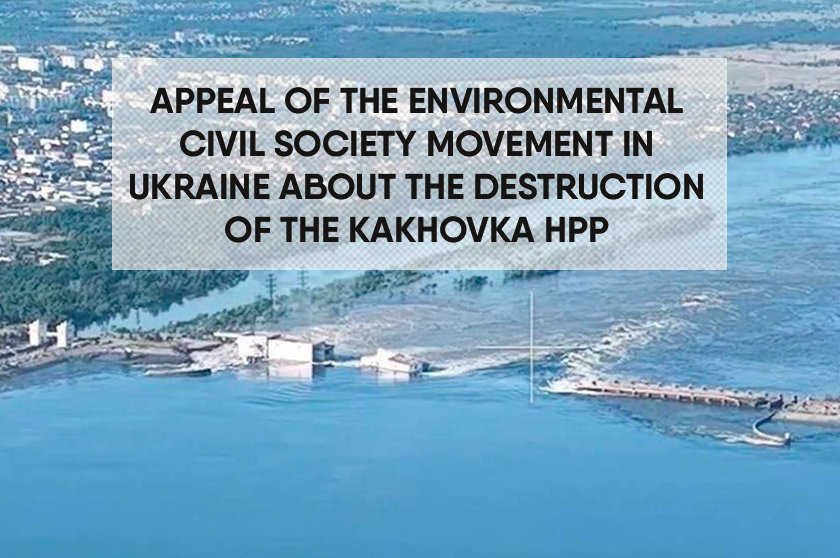
Representatives of environmental civil society movement in Ukraine appeal to our colleagues in the area of environmental protection, international experts, institutions that aim to protect the environment, secretariats of international environmental conventions, authorized bodies, and individuals of the United Nations within their mandates and capabilities and request to respond to the latest act of ecocide by the Russian Federation, which occurred during the explosion of the Kakhovka Hydroelectric Power Plant (HPP).
On June 6, 2023, Russian occupiers committed another act of ecocide that causes threats of unprecedented environmental consequences for the South of Ukraine and the whole Black Sea region.
Hydropower dams have always been subject to high technological risks. The consequences of this criminal destruction of the Kakhovka Hydroelectric Power Plant (HPP), include:
- destruction and significant disruption of ecosystems in the Kakhovka reservoir and the water bodies that flow into it, as well as the areas downstream of the Dnipro River, the Dnipro Estuary, and the disturbance of ecosystems in the coastal area of the Black Sea;
- potential mass mortality of aquatic organisms (fish, mollusks, crustaceans, microorganisms, aquatic vegetation) in the Kakhovka reservoir, leading to deterioration of water quality due to decomposition of dead organisms;
- disruption of the habitats of fish, mollusks, crustaceans, birds, amphibians, and other animals inhabiting water bodies and coastal complexes from the Kakhovka reservoir and downstream to the Kinburn Peninsula;
- disruption of habitats and potential loss of animals inhabiting the terrestrial areas that will be flooded. There are significant risks to rodent populations, including endemic species and those listed in the Red Book of Ukraine;
- disruption of plant ecosystems: coastal aquatic vegetation upstream of the Kakhovka HPP dam will die due to drainage, while areas located downstream will be flooded, including steppe and forest complexes that are not adapted to being submerged, leading to their waterlogging and destruction. Downstream of the Dnipro River, there are endemic species listed in the IUCN Red List that are not found anywhere else in the world;
- unpredictable deposition of river sediments and eroded materials from the land surface;
- negative impact on the water bodies, coastal areas, and terrestrial parts of three Ukrainian national nature parks – “Nyzhniodniprovs’kyi,” “Kam’yanska Sich,” “Biloberizhzhia Sviatoslava,” the Black Sea Biosphere Reserve (which is also a UNESCO biosphere reserve), the Regional Landscape Park “Kinburn Spit,” and numerous objects of the nature reserve fund with smaller areas, as well as potential impact on planned nature conservation areas. These areas also have the status of Wetlands of International Importance protected under the Ramsar Convention and are part of the Emerald Network protected under the Bern Convention;
- disruption of water supply to facilities in the Kherson and partially in the Zaporizhia regions;
- pollution of the Dnipro River’s waters – primary pollution resulting from the washing away of garbage, agrochemicals, and other hazardous materials, as well as the flooding and disabling of wastewater treatment systems and sewage systems. This leads to secondary pollution caused by the disturbance of sediment layers, where pollutants have accumulated for decades;
- flooding of houses, buildings, enterprises;
- property loss and destruction;
- death of cattle, livestock, domestic animals, animals in zoos, the corpses of which in hot weather will contaminate water, soil, pollute air and pose a danger of spreading infectious diseases;
- impediment or complete impossibility of water supply for agricultural needs in the southern part of the Kherson region;
- erosion, displacement of mines and other explosive materials, increasing the mine risks;
- impeded or impossible water intake necessary for cooling the Zaporizhia Nuclear Power Plant, posing a threat to global nuclear safety;
- change of the mesoclimate of the area due to changes in the surface area of the water reservoir, violation of the water balance, and increased open land areas;
- inability to regulate water levels during waterlogging and floods. The destruction of the Kakhovka HPP dam eliminates the protection of downstream objects, leading to the risk of re-flooding areas dependent on regulation by the Kakhovka HPP.
…
This crime is another serious incentive for Ukraine’s partners to speed up the establishment of a tribunal for the Russian Federation and Belarus, as well as to supplement the Rome Statute with such a crime as ecocide.
We call on the international community to provide assistance to Ukraine in gathering evidence, assessing all the consequences of such a crime on the environment, in taking quick measures to reduce and mitigate the consequences for the environment and population of southern Ukraine, to activate the international environmental community in determining measures to reduce the consequences of such a crime on the Black Sea environment and to develop mechanisms to prevent such environmental destruction in future.
This statement is open for signing and dissemination! The full text of the appeal