Conclusions of the discussion
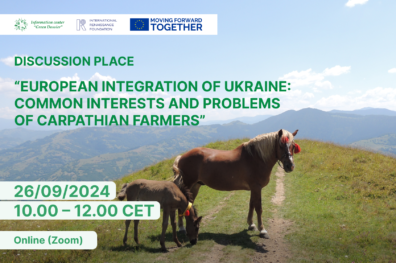
The latest meeting on the discussion place took place on Carpathian Day, officially celebrated for the first time this year in the countries of the Carpathian Convention and was held under the slogan “Our Identity lies in Our Heritage.”Therefore, the topic of traditional farming in the Carpathians and the possibilities for its further development and support was a priority.
Our colleagues from the Carpathian countries visited farms in Transcarpathian in the summer, in frames of the project. The perspective of colleagues- neighbours on our achievements and challenges, as well as their own experience in overcoming similar issues, is a valuable contribution to our movement towards the European community. The participants of the trip shared their impressions and reflected on possible cooperation with Ukrainian farmers, already following the rules of the European Union, which Ukraine aspires to join. While noting the successes of Ukrainian farmers, they also paid attention to the peculiarities of the common market and new challenges that may arise soon.
Key conclusions of the discussion:
- During the trip, our guests noticed and appreciated the well-established small enterprises, their creative approach to producing diverse products, effective use of modern marketing techniques, and strong support from local communities, along with the ability to cooperate and provide mutual assistance.
However, as small farmers prepare for EU accession, they must recognise that an open market will bring competition from large international brands, potentially putting them at a disadvantage due to limited access to modern production automation. They will also face the need to comply with complex new regulations.
Furthermore, the opening of the market could increase westward migration, leading to labor shortages, particularly among younger workers. Despite these challenges, European integration offers solutions, such as mechanisms for direct and indirect government support, subsidies for farmers and shepherds (e.g., predator protection, road construction, and infrastructure development), making remote areas more accessible for both farmers and tourists. Quality and geographic origin labelling systems aim to protect local producers from competition.
The key is to consistently inform farmers about available opportunities and assist them in finding pathways toward sustainable development.
- Carpathian pastoralism represents a way of life and forms the basis of authentic identity, deeply rooted in the culture and history of the highlands. These pastures, often located in geographically challenging areas unsuitable for other forms of agriculture, provide a vital livelihood for mountain communities. The well-being of these communities depends on preserving the region’s biodiversity, landscapes, and water resources.
Ongoing efforts aim to have Carpathian pastoralism (transhumance) recognized on UNESCO’s Intangible Cultural Heritage list. This movement, which Ukraine has already joined, provides a fertile environment for cooperation, where countries inspire each other, starting from the first stage of this process – the inclusion of this phenomenon in national representative lists of intangible cultural heritage. In such cooperation, we have to study the international experience of pastoralism and develop educational programs for pastoral communities, in particular, knowledge of farm management, including its economic component, ways of generating positive income and marketing strategies.
The key is communication and cooperation with international structures (UNESCO, Year of Rangelands and Pastoralism), popularisation of pastoral communities and movement in Ukraine, as a way of preserving traditional farming, culture, and lifestyle, as well as the development of tourism, prestige and popularisation of local values.
- The Carpathian region is vulnerable to the effects of climate change, particularly affecting farmers through reduced water resources and extreme weather events. At the same time, the region is part of the solutions to this problem, solutions that are called nature-oriented.
The Carpathians are called the “green lungs of Europe”, they are home to large areas of primary, or old-growth forests, which store more carbon and support greater biodiversity than planted or managed forests. Therefore, the priority should be to preserve existing forests, both primary and secondary, and allow them to develop to their maximum carbon storage potential.
The European Union has committed to the conservation, restoration and thinning of forests through legislative and financial mechanisms. Local communities in Ukraine should be involved in the formation of agricultural and environmental policy and the legislative framework.
The key is to use the potential of cooperation between the Carpathian countries and stakeholders to solve common challenges and work on joint strategic plans aligned with the European Green Deal and European Union policies.
- The people of the Carpathians are the beauty of the region. It is important to show it together with the beauty of nature to raise the prestige of farming and inspire others. The synergy of agriculture and tourism contributes not only to the economic growth of communities but also to the promotion of local values, environmental and cultural heritage, which most farmers are committed to preserving. Responsible farmers must be supported so that they do not leave the land due to local corruption schemes and irresponsible destructive projects.
The key is to support not only products but also culture and social life – then the Carpathians have the potential to become a territory of innovations and advanced agrarian policy.
We continue the discussion and invite you to the next meeting on the virtual Discussion Place, which will take place on November 12.
This article prepared in the frame of “Green and inclusive agricultural policy – steps towards” project implementing by ICO IC «Green Dossier» with the support of the European Union and the International Renaissance Foundation within the framework «European Renaissance of Ukraine» project.
Its content is the exclusive responsibility of the authors and does not necessarily reflect the views of the European Union and the International Renaissance Foundation.