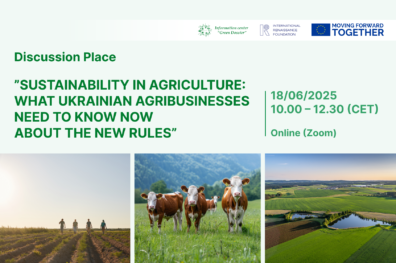
(based on the Green Dossier Discussion Place)
On June 18, our Discussion Place brought together representatives of agribusiness, environmental organizations, advisory services, academic institutions, local authorities, and international programs supporting Ukrainian agriculture. We also made a point of involving experts from the financial sector, as the core issue is implementing financial mechanisms in Ukraine to support sustainable business development.
CSRD, ESG, CSDDD: The European Agenda for Ukraine
These abbreviations are increasingly present in the agenda of Ukrainian agribusinesses and consulting services. While these concepts are not fundamentally new—they reflect the UN principles of sustainable development long accepted in the EU. For Ukraine, the shift became tangible only when the EU integration process introduced concrete obligations: to report on environmental, social, and governance impacts.
The European Union is a global leader in shaping sustainability policy through ambitious goals, robust legislation, and a focus on transforming economies and societies. Several EU laws now require companies to submit non-financial reports.
Ukraine’s Context: Legislation, Practice, and Challenges
Currently, there are no legal obligations in Ukraine for sustainability reporting, but it’s only a matter of time. As part of aligning its legislation with EU law, Ukraine will inevitably introduce such requirements. For now, sustainability reporting is voluntary, but many businesses choose to follow those standards because of better access resources and partner expectations. Investor demands, EU partnerships, and loan conditions also push companies toward transparency.
One practical step forward is the national Strategy for the Introduction of Sustainability Reporting, aligned with CSRD, ESRS, EU Taxonomy, and SFDR. It includes regular monitoring, evaluation, training programs, audit mechanisms, and investment facilitation.
Large Businesses Take the Lead, Small Farmers Lag Behind
Major agribusinesses are already introducing sustainability units or officer positions. As Denis Shofolov (sustainable development manager and leader of the ESG project of the large agricultural company Continental Farmers Group) noted, ESG implementation has become a tool to improve business models and operational efficiency.
Small farmers, however, are still unfamiliar with these concepts, – Oksana Prosolenko CEO of consulting center I.P.Cert, noted. The research recently represented by the Green Transition Office shows only 5% of businesses are ready to report on sustainability, and 29% have never heard of it.
But when a farmer applies to banks, they already ask for ESG-related data when issuing loans. Fortunately, experts and consultants are available to help gather and report this information—for example, with the support of the Partial Credit Guarantee Fund in agriculture.
Where to Find Support for the Green Transition
An independent advisory body under the Ministry of Economy, The Green Transition Office, offers research, tools, and guidance. The ESG Knowledge Hub was launched there as well.
The Independent Association of Ukrainian Banks has established a special ESG structure. SaveEcoBot system provides an ESG company profile tool.
Civil society organizations also work with financial institutions and businesses to support responsible companies in adopting European sustainability standards.
Yet, as our participants noted, there is an acute shortage of qualified sustainability experts. Even in EU countries, implementation of social and environmental standards faces challenges. Farmers are often dissatisfied, and a simplification package (Omnibus) is currently under development. We will continue monitoring these changes and providing Ukrainian agribusinesses with relevant guidance.
Thanks to all our participants! Speakers presentations and recordings are available on our website, along with a useful materials and links in the Library sector (Ukrainian only).
Materials of the event:
This article prepared in the frame of “AgriFuture UA: Driving Sustainable Agriculture and EU Integration through CSOs” project implementing by ICO IC «Green Dossier» with the support of the European Union and the International Renaissance Foundation within the framework «European Renaissance of Ukraine» project.
Its content is the exclusive responsibility of the authors and does not necessarily reflect the views of the European Union and the International Renaissance Foundation.